

$47 million allocated for new Richland laboratory to utilize AI for quicker scientific advancements
- Last update: 3 hours ago
- 3 min read
- 443 Views
- BUSINESS
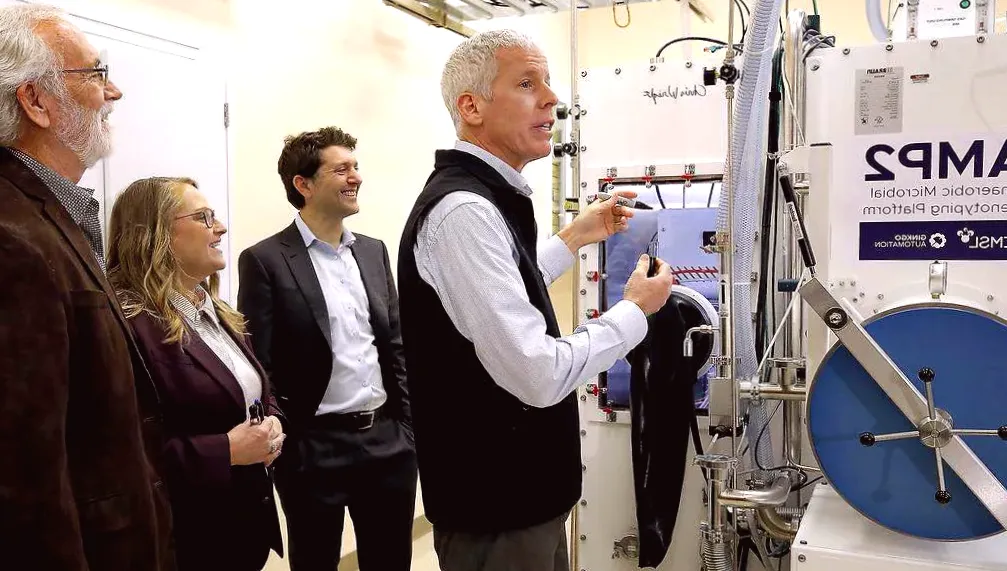
Microscopic organisms, invisible to the naked eye, are at the heart of a groundbreaking project in the Tri-Cities area, pioneering the use of artificial intelligence to speed up scientific discoveries. U.S. Energy Secretary Chris Wright inaugurated a cutting-edge AI system at the Pacific Northwest National Laboratory (PNNL) in Richland on Thursday, marking the launch of a platform designed to dramatically accelerate biological research.
The system, named the Anaerobic Microbial Phenotyping Platform (AMP2), represents the initial phase of broader work at PNNL under the U.S. Department of Energys Genesis Mission, an initiative to integrate AI into scientific research. Our goal is to increase the pace of discovery and innovation through collaboration between our labs and commercial partners, fostering an environment that rewards creativity, Wright said.
A $47 million contract has been awarded to Ginkgo Bioworks of Boston to construct a facility ten times larger than the prototype currently at PNNLs Environmental Molecular Sciences Laboratory (EMSL). The planned 32,000-square-foot addition will house 100 advanced analytical instruments and serve as a hub where researchers compete for access to state-of-the-art equipment and expertise.
Construction will begin next year, with the new Microbial Molecular Phenotyping Capability (M2PC) expected to be operational by 2030. Meanwhile, the prototype facility at EMSL will start research projects next month.
Autonomous Labs Driven by AI
Like its prototype, the M2PC will operate autonomously, allowing scientists to propose hypotheses and have the system execute experiments independently. Robotic arms will handle tasks such as filling and transferring samples around the lab, running continuously without human oversight. AI will immediately analyze results and determine the next experimental steps, dramatically increasing the speed of research while still allowing scientists to guide experiments.
Autonomy combined with AI is transforming laboratory work, enabling researchers to accomplish in days what previously took months or years, said Douglas Mans, interim director of Earth and Biological Sciences at PNNL.
Unlocking the Mysteries of Microbes
Microbes, including bacteria and fungi, represent the largest reservoir of biological activity on Earth, yet scientists have explored only a fraction of species. We know almost nothing about 95% of microbes, Wright explained. Integrating AI with autonomous systems will provide a much more complete understanding of microbial phenotypesthe characteristics of organisms such as growth rates, preferred conditions, and biochemical production.
Scott Baker, a PNNL scientist, likened this approach to upgrading from a grainy black-and-white photo to a full-color, 360-degree view of microbial life. The research could accelerate the development of medicines for diseases like Alzheimers and cancer, create new energy materials, and improve industrial processes by predicting microbial behavior instead of relying on trial and error.
AI-Enhanced Biotech and Economic Impact
One project under the Genesis Mission will explore using bacterial acids to extract valuable metals like lithium and cobalt from mine waste. The global bioeconomy, currently valued at over $4 trillion, is projected to exceed $30 trillion within three decades.
Senator Maria Cantwell emphasized that the Washington life sciences sector already supports over 100,000 jobs and that PNNLs AI biotech platform will position the state as a leader in new medicine, sustainable materials, and clean energy. Wright noted that increased research efficiency will create even greater demand for scientists, further fueling innovation.
Enhancing, Not Replacing Scientists
AMP2 and M2PC are designed to augment scientists work rather than replace them. Automation and AI are tools for genuine scientific breakthroughs, allowing us to run far more experiments and gain insights previously unimaginable, Mans said.
During his visit to PNNL, Wright also toured the lab as part of his commitment to visit all 17 U.S. national labs in 2025, accompanied by Representative Dan Newhouse.
Author: Harper Simmons
Share

$47 million allocated for new Richland laboratory to utilize AI for quicker scientific advancements
3 hours ago 3 min read BUSINESS

$47 million allocated for the new Richland laboratory to utilize AI in accelerating scientific breakthroughs
4 hours ago 3 min read BUSINESS

$47 million allocated for new Richland laboratory utilizing AI to accelerate scientific breakthroughs
4 hours ago 3 min read BUSINESS

Mark Kelly Raises Questions About Life Beyond Earth with Exciting Scientific Find
1 days ago 2 min read WORLD
Over 1,000 Amazon workers express concerns about the company's AI impact on democracy, jobs, and the environment
2 days ago 4 min read BUSINESS
More than 1,000 Amazon workers criticize company's controversial AI usage in a letter: 'Moving towards a more militarized surveillance state'
3 days ago 2 min read BUSINESS

Licking Heights High School students explore forensic science with Amgen
6 days ago 3 min read SCIENCE
: Modesto JC awarded $400k grant by National Science Foundation. What will the grant be used for?
6 days ago 1 min read SCIENCE