

$47 million allocated for the new Richland laboratory to utilize AI in accelerating scientific breakthroughs
- Last update: 4 hours ago
- 3 min read
- 314 Views
- BUSINESS
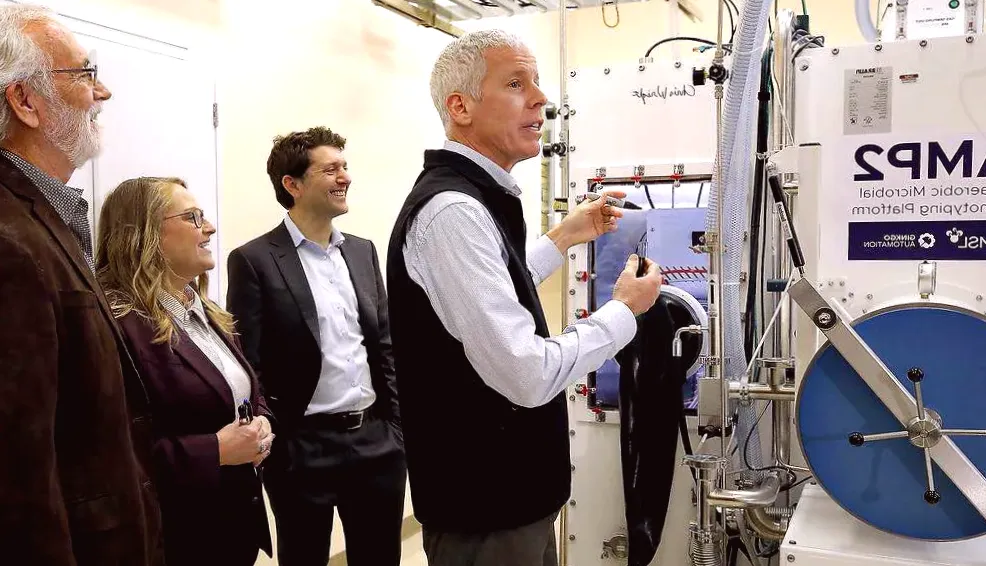
Invisible microorganisms are taking center stage in a major initiative in the Tri-Cities region, where artificial intelligence is being deployed to transform the pace of scientific breakthroughs. On Thursday, U.S. Energy Secretary Chris Wright inaugurated a groundbreaking AI system at the Pacific Northwest National Laboratory (PNNL) in Richland.
The system, called the Anaerobic Microbial Phenotyping Platform (AMP2), aims to drastically speed up biological research, enabling discoveries that could improve lives and strengthen the nations scientific capabilities. AMP2 represents just the first step in a broader project under the federal Genesis Mission, an effort to integrate AI into scientific research.
Our focus is on accelerating scientific discovery and engineering innovation through collaboration among national labs, industry partners, and an environment that rewards creativity and innovation, Wright stated.
A $47 million contract from the Department of Energys Office of Science has been awarded to Ginkgo Bioworks in Boston to construct a new facility that will provide ten times the laboratory space of the AMP2 prototype at PNNLs Environmental Molecular Sciences Laboratory (EMSL). This 32,000-square-foot addition will house 100 advanced instruments for scientific experiments and serve as a hub where researchers can access sophisticated equipment and PNNL expertise.
Construction is set to begin next year, with the full-scale Microbial Molecular Phenotyping Capability (M2PC) expected to be operational by 2030. In the interim, AMP2 will start research projects next month.
Autonomous Research Powered by AI
Like its prototype, M2PC will operate autonomously, similar to self-driving vehicles. Scientists will design experiments and the AI-driven system will execute and analyze them. Robotic arms will handle tasks like filling, loading, and transporting sample containers around the lab continuously. Beyond routine tasks, the platform will orchestrate sequences of experiments, allowing AI to select the next research steps based on real-time results, dramatically increasing research throughput.
Autonomy and AI are transforming scientific methods, allowing laboratories to achieve in days what previously required months or years, said Douglas Mans, interim director of Earth and Biological Sciences at PNNL.
Unlocking Microbial Mysteries
Microbes, including bacteria and fungi, constitute the largest reservoir of biological function on Earth, yet 95% of them remain largely unstudied. By combining AI with autonomous experimentation, scientists hope to move from limited understanding to a comprehensive, detailed picture of microbial behavior.
The AMP2 and M2PC systems will examine microbial traits such as growth rate, nutrient preferences, and compound production over time. These characteristics, known as microbial phenotypes, are crucial for advancing medicine, sustainable materials, and industrial applications.
Research outcomes could accelerate the development of treatments for Alzheimers and cancer, enhance energy solutions, and optimize microbial use in industry. One planned study will explore using bacterial acids to extract valuable metals like lithium and cobalt from mining waste, showcasing AI-guided efficiency over traditional trial-and-error methods.
Economic and Workforce Impacts
The global bioeconomy, currently valued at over $4 trillion, is projected to surpass $30 trillion within 30 years. Washingtons life sciences sector already supports over 100,000 jobs, and this new AI-driven biotech platform will further position the state as a leader in cutting-edge industries, said Sen. Maria Cantwell.
Wright emphasized that increased automation and AI will expand the demand for scientists, enhancing productivity while supporting innovation. According to Ginkgo Bioworks CEO Jason Kelly and PNNL experts, these systems are designed to complement scientists, not replace them, enabling far more experiments and insights than previously possible.
During his visit to PNNL, Wright also toured the lab as part of his nationwide tour of all 17 Department of Energy national laboratories in 2025, with Representative Dan Newhouse accompanying him for the Richland stop.
Author: Connor Blake
Share

$47 million allocated for new Richland laboratory to utilize AI for quicker scientific advancements
3 hours ago 3 min read BUSINESS

$47 million allocated for the new Richland laboratory to utilize AI in accelerating scientific breakthroughs
4 hours ago 3 min read BUSINESS

$47 million allocated for new Richland laboratory utilizing AI to accelerate scientific breakthroughs
4 hours ago 3 min read BUSINESS

Mark Kelly Raises Questions About Life Beyond Earth with Exciting Scientific Find
1 days ago 2 min read WORLD
Over 1,000 Amazon workers express concerns about the company's AI impact on democracy, jobs, and the environment
2 days ago 4 min read BUSINESS
More than 1,000 Amazon workers criticize company's controversial AI usage in a letter: 'Moving towards a more militarized surveillance state'
3 days ago 2 min read BUSINESS

Licking Heights High School students explore forensic science with Amgen
6 days ago 3 min read SCIENCE
: Modesto JC awarded $400k grant by National Science Foundation. What will the grant be used for?
6 days ago 1 min read SCIENCE