

Alert issued for geomagnetic storm following strong solar flare
- Last update: 2 hours ago
- 2 min read
- 798 Views
- WORLD
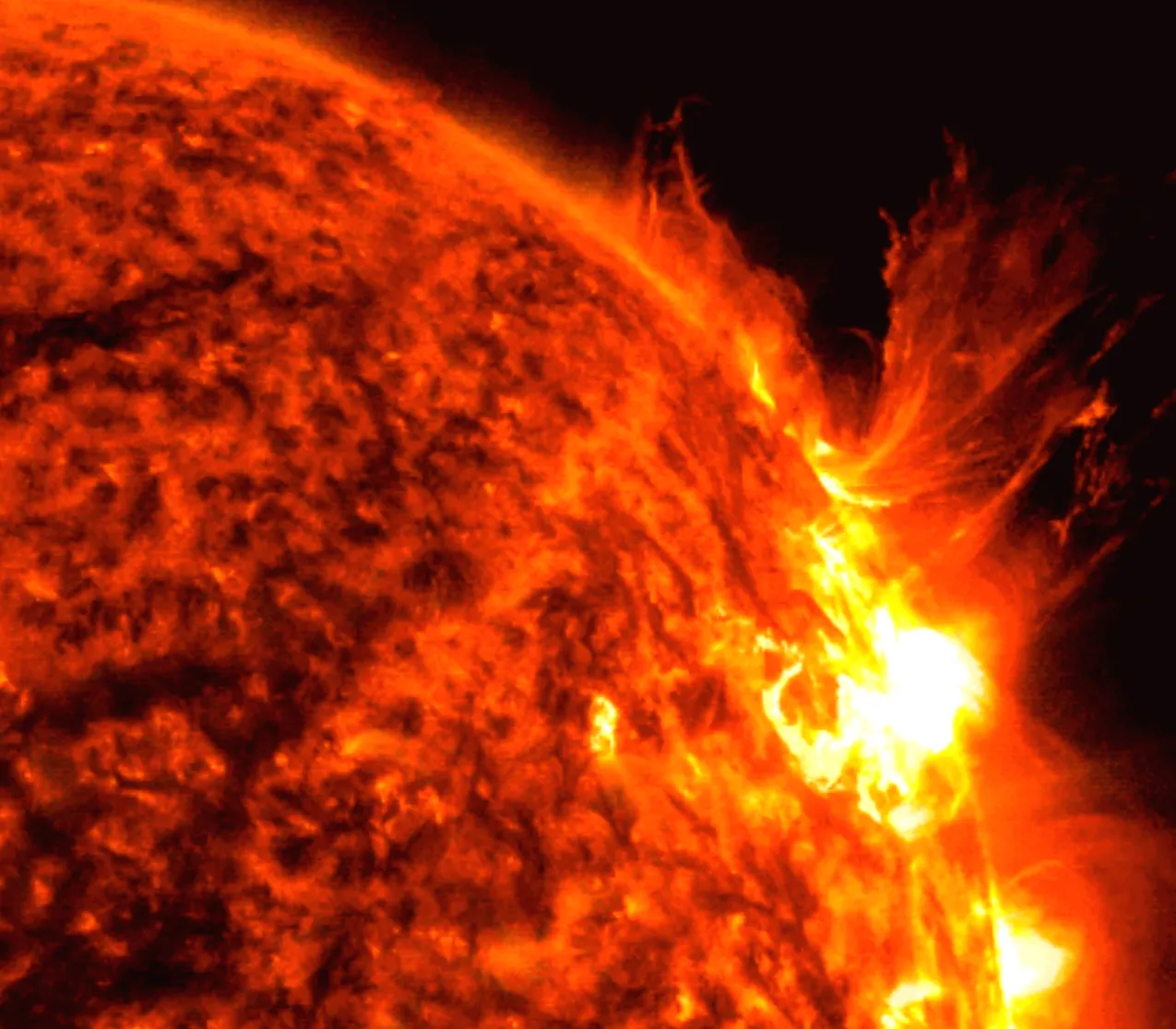
Authorities have issued a geomagnetic storm alert after a significant solar flare occurred over the weekend. According to NASA's Solar Dynamics Observatory, which continuously observes the Sun, the flare reached its peak at 9:49 p.m. EST on Sunday, November 30.
The event was classified as an X1.9 flare, indicating one of the strongest types of solar flares. The eruption originated from a recently developed sunspot region on the Sun's surface. The flare temporarily disrupted radio communications in Australia and parts of Southeast Asia earlier this week.
Alongside the flare, a coronal mass ejection (CME) was also detected. CMEs involve the expulsion of solar material and magnetic fields into space. While flares and CMEs are related solar phenomena, they differ in structure and impact. Both can interfere with radio signals, power systems, and navigation equipment, and they may present hazards to spacecraft and astronauts.
When directed toward Earth, CMEs can trigger geomagnetic storms, according to the National Oceanic and Atmospheric Administration (NOAA). A geomagnetic storm watch has been set for Thursday, December 4. Although the CME is not anticipated to directly strike Earth, it may still cause minor disturbances to certain technologies. NOAA warns that the timing is uncertain, and the storm could potentially arrive as early as December 3.
The Northern Lights might be visible across northern U.S. states and areas stretching from New York to Idaho. However, adverse weather conditions, including a strong winter storm, could reduce viewing opportunities.
NOAA also predicts a period of heightened solar activity from December 1 through December 5, as the newly formed sunspot region, labeled AR4299, rotates into an Earth-facing position. This is the same region responsible for the recent solar flare and CME.
Author: Caleb Jennings
Share
Indonesia to send back 2 Dutch drug traffickers, one facing death penalty
59 seconds ago 2 min read WORLD

Researchers Discover a Puzzling New Organism Resembling a Living Sun
1 minutes ago 3 min read WORLD

Hegseth justifies attacks on suspected cartel boats
10 minutes ago 2 min read WORLD
Uruguay approves deep-water oil exploration despite increasing environmental criticisms
12 minutes ago 2 min read WORLD

Hong Kong residents vote after tragic fire incident
14 minutes ago 3 min read WORLD

RadPartners chooses DataFirst for data migration services
21 minutes ago 2 min read WORLD

23 people killed in nightclub fire in Goa, India
29 minutes ago 2 min read WORLD

Thieves pilfer 20,000 rounds of German military ammunition while truck driver dozed off
32 minutes ago 2 min read WORLD

Canada looks to secure discounted access to EU weapons programme due to Britain's high pricing
32 minutes ago 2 min read WORLD

View images of people sledding, shoveling, and snow-covered landscapes throughout the US
36 minutes ago 2 min read WORLD