

Eurovision participants discuss proposal to boycott Israel
- HOME
- ENTERTAINMENT
- Eurovision participants discuss proposal to boycott Israel
- Last update: 1 hours ago
- 3 min read
- 437 Views
- ENTERTAINMENT
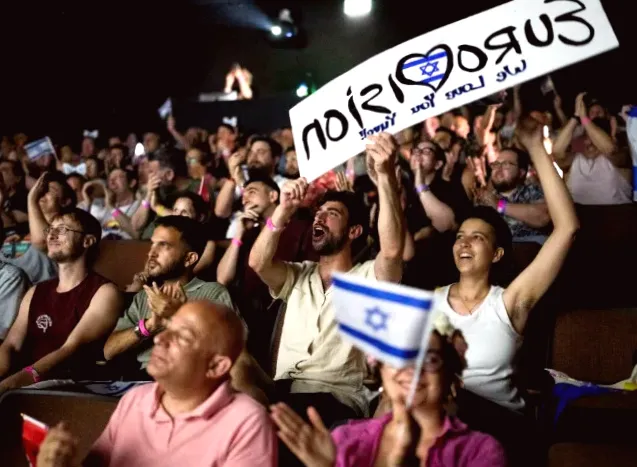
The organisers of the Eurovision Song Contest, the largest music event globally, initiated a two-day meeting on Thursday to discuss Israel's future involvement in the competition, following growing calls for its exclusion, particularly in light of the ongoing conflict in Gaza. Representatives from the European Broadcasting Union (EBU) gathered in Geneva for closed-door discussions under heightened security, prompted by threats of widespread withdrawals from next year's event if Israel is allowed to participate.
In addition to debating Israel's participation, voting procedures were also discussed after Israel's Yuval Raphael, a survivor of the October 7, 2023 Hamas attack, secured second place in the overall standings following the public vote. This has raised concerns about potential voting manipulation. Similar issues were raised the previous year when Israel's Eden Golan unexpectedly jumped to fifth place despite weak scores from national juries.
Eurovision entries are judged by professional juries first, followed by a public vote through phone, text, or online voting. This often results in dramatic shifts in the leaderboard. Countries such as Iceland, Ireland, Spain, and the Netherlands have threatened to withdraw from the event next year if Israel participates, while others, including Belgium, Finland, and Sweden, have hinted they might join a boycott due to the situation in Gaza.
Jose Pablo Lopez, head of Spain's public broadcaster RTVE, expressed on Thursday that the EBU had subjected itself to "the greatest internal tension in its history" by failing to act sooner. He argued that sanctions against Israel for its repeated violations in Eurovision should have been addressed at the executive level, rather than through a broader assembly decision. He posted on X that the conflict should not have been allowed to escalate to this point.
Dutch broadcaster AVROTROS also explained its position, stating that Israel's "serious violations of press freedom" in Gaza justified their threat to pull out of Eurovision. Additionally, AVROTROS accused Israel of "proven interference" during the previous contest by lobbying international audiences to vote for it, which they deemed a violation of the competition's rules.
While the EBU initially planned to hold a vote on Israels participation in November, the announcement of a ceasefire between Israel and Hamas on October 10 led to a delay in the decision. The EBU has now pushed the discussion to its General Assembly meeting on December 4 and 5. In an attempt to avoid further controversy, the EBU recently modified Eurovision's voting rules to address member concerns and to enhance "trust and transparency" within the competition.
Broadcasters will now decide whether these new measures are sufficient or if a vote on Israel's participation is still necessary. Finlands national broadcaster Yle announced on Thursday that it would base its participation decision on the outcome of the EBU General Assembly discussions and vote. Austria, which will host the 2026 Eurovision, has expressed hope that a consensus will be reached to ensure the inclusion of as many participants as possible.
However, other broadcasters have argued that the changes do not go far enough. Icelands RUV has declared that it will call for Israels exclusion before making its own decision regarding participation in 2026. Spains RTVE reiterated its intention to boycott if Israel is allowed to compete, accusing the country of using Eurovision for "political purposes." Slovenias RTVS is expected to follow suit, as its recent budget did not allocate any funds for participation. However, RTVS head Natasa Gorscak stated that Slovenia would reconsider if Israel is excluded.
Excluding a country from Eurovision is not unprecedented. Russia was banned from the 2022 contest after its invasion of Ukraine, and Belarus was excluded a year earlier due to the disputed re-election of President Alexander Lukashenko.
Author: Maya Henderson
Share

Eliminate back pain with this yoga teacher’s 2-step routine for reducing tension and improving mobility
58 seconds ago 4 min read ENTERTAINMENT

Revival of Erotic Thriller Genre: Peacock Adds to Trend with Mandy Moore Series ‘Teach Me’, One of 8 Current Film & TV Projects in the Genre
1 minutes ago 3 min read ENTERTAINMENT

Nick Fuentes publicly ends relationship with 'fake' Tucker Carlson: 'Keep your distance from me!'
5 minutes ago 4 min read ENTERTAINMENT

'Mad Men' Actor Shares Battle With Neurological Disorder, Confronts Family Member's 'Cruel' Actions
6 minutes ago 3 min read ENTERTAINMENT
Review of 'Little Trouble Girls': Urška Djukić's Debut Film Explores Queer Teen Desire in Slovenian Choirgirl Drama
9 minutes ago 4 min read ENTERTAINMENT

Storm-damaged harbour receives new lock gate
10 minutes ago 2 min read ENTERTAINMENT

Hugh Jackman's Efforts to Impress Sutton Foster Revealed — Insider
13 minutes ago 2 min read ENTERTAINMENT

Gwen Stefani's Bold Combination of Micro Shorts and Fishnet Stockings
14 minutes ago 2 min read ENTERTAINMENT

CBS renews 'Boston Blue' and 'Fire Country' for second seasons
14 minutes ago 1 min read ENTERTAINMENT

Nashville updates: Cody's latest duet, Miranda's rodeo adventures and more
15 minutes ago 2 min read ENTERTAINMENT