

Fabergé's Winter Egg: The Greatest of All, Set to Break Auction Records
- Last update: 3 days ago
- 3 min read
- 23 Views
- STYLE
Curio, a CNN Style series, explores the fascinating stories behind small objects. Soon, even the wealthiest collectors might find themselves unable to acquire a Faberg Imperial Egg. The legendary jewelry pieces, crafted by the St. Petersburg house for Russian Tsars Alexander III and Nicholas II between 1885 and 1916, were limited to just 50 creations. Seven of these eggs have vanished, some not seen since before the Russian Revolution, while the rest reside in museums from Moscow to Virginia. Only seven remain in private hands, and of these, just three are considered truly available for purchase, according to Faberg specialist Kieran McCarthy of Wartski, a British antique jewelry dealer.
For the first time in more than 20 years, one of these three privately owned eggs will go under the hammer. Auction house Christies expects the 1913 Winter Egg to fetch over 20 million ($26 million) at its London sale on December 2. If successful, it would set a new record for a Faberg egg, surpassing the Winter Eggs own auction record from 2002.
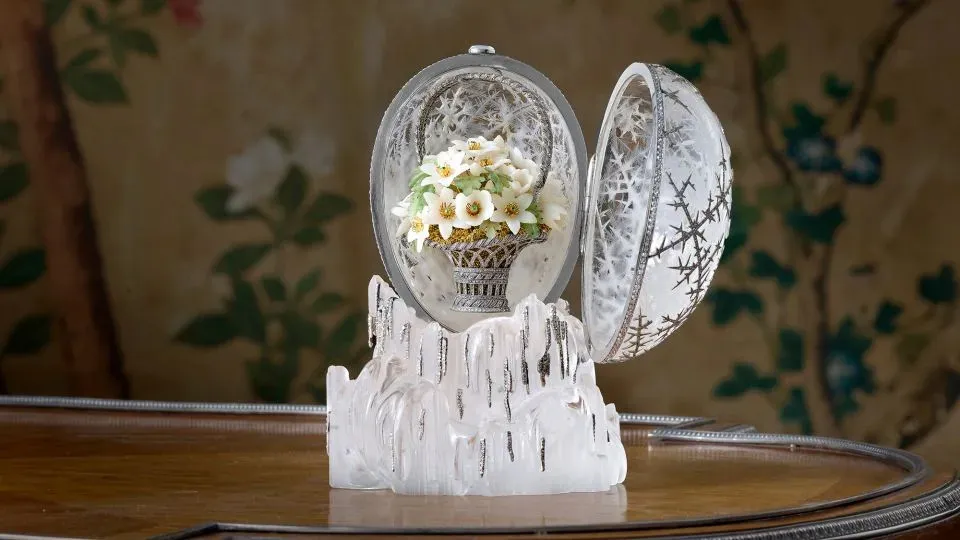
The Winter Egg is celebrated for its artistry. Carved from clear quartz, it appears as if sculpted from ice, with frosted engravings and platinum accents reminiscent of thawing sunlight. Around 4,500 tiny diamonds embellish the piece, creating a sparkling effect that emphasizes the delicate design rather than intrinsic material value. McCarthy described holding it as like holding a lump of ice in your hand, calling it alchemy in reverse, turning precious materials into a moment of nature.
True to Faberg tradition, the egg opens to reveal a surprise. Unlike the mechanical novelties typical of Imperial Eggs, the Winter Eggs secret is a suspended basket of wood anemones, early spring flowers in Russia. Each petal is carved from white quartz, with nephrite stems and garnet accents. McCarthy, curator of the 2021 Victoria & Albert Museum exhibition Faberg in London: Romance to Revolution, called it arguably the greatest of them all and the most iconic Russian work of art. Margo Oganesian, Christies head of Faberg and Russian art, praised it as the most spectacular and unusual of the Imperial Eggs, with invoices confirming its historic valueNicholas II paid 24,600 rubles, the third-highest sum Faberg ever charged.
While the quartz is not rare, its brittle nature made crafting the egg particularly challenging. The Winter Eggs diamonds are valued for their artistic arrangement rather than size or quality. Nicholas II commissioned it for his mother, Dowager Empress Maria Feodorovna, who annually received an Imperial Egg from her late husband, Alexander III. Faberg received no instructions, allowing the artist freedom to surprise the recipient.
The design stands apart from typical ornate Faberg eggs, reflecting a simple, modern aesthetic rather than historical styles. Its creation is credited to Alma Pihl, one of Fabergs rare female workmasters. Inspired by frost patterns observed on a workshop window, she conceptualized the egg, with execution completed by a team of jewelers. Delivered shortly before World War I, it survived the Russian Revolution and was sold in the 1920s or 1930s to Wartski for just 450, before passing through private collections and disappearing for nearly two decades from 1975.
Rediscovered in 1994, it sold at Christies Geneva for over 7.2 million Swiss francs (then $5.6 million), setting an auction record, which it broke again in 2002 with a $9.6 million sale. Christies has confirmed the 2002 buyer, described as a noble, is offering it in the upcoming sale, though the new owners identity remains private. Experts note that the primary markets, the U.S. and Russia, present challenges due to tariffs and sanctions, complicating the eggs potential destination. Christies maintains rigorous anti-money laundering and sanctions compliance protocols for its auctions.
Author: Sophia Brooks
Share

Emma Roberts and Her Identical Doll Wear Coordinating Outfits
40 minutes ago 1 min read STYLE

Yet another unique Hermes Birkin bag sold for $2.86 million
1 hours ago 2 min read STYLE

Kristen Stewart donned Calvin Klein Collection at the IndieWire Honors Winter Film Awards 2025.
1 hours ago 2 min read STYLE

Jimmy Choo Makes a Statement at Miami Art Week with Oversized Silver Chrome Shoe
1 hours ago 2 min read STYLE

Parodi Costume Collection Reveals Exhibition Dedicated to Japanese Fashion
2 hours ago 3 min read STYLE

Huishan Zhang Pre-Fall 2026: Voyage to Another Place
3 hours ago 2 min read STYLE

Gandhi's London statue model to be auctioned
3 hours ago 2 min read STYLE

Latin American artists steal the spotlight at Art Basel Miami 2025
3 hours ago 3 min read STYLE

Kylie Jenner's Favorite Jeweler Steff Eleoff Starts International Launch at Selfridges, Loved by Haylie Bieber
3 hours ago 2 min read STYLE

Emma Roberts Takes a Photo With a Doll Who Looks Just Like Her in Matching Clothes
3 hours ago 1 min read STYLE