

NASA Unveils Fresh Photos of Interstellar Comet 3I/ATLAS That You Must Check Out
- Last update: 22 hours ago
- 2 min read
- 513 Views
- WORLD
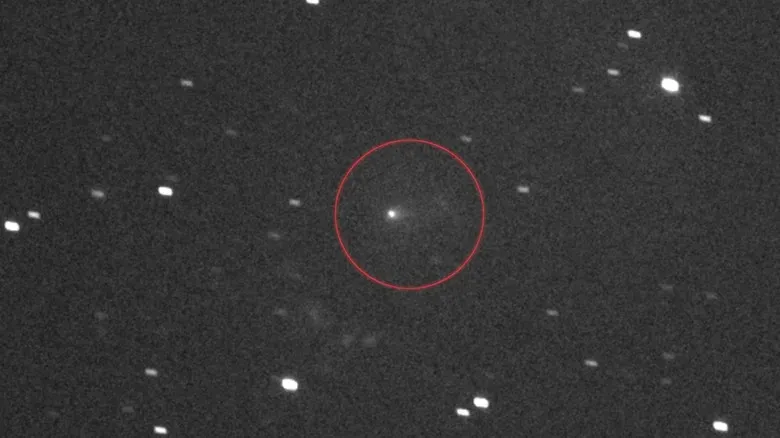
Comet 3I/ATLAS marks the third interstellar visitor ever detected passing through our solar system. This celestial object was first spotted on July 1, 2025, by the ATLAS telescope in Chile, a project supported by NASA. Since its discovery, twelve NASA instruments have captured images of the comet, and the latest collection, taken between late September and mid-October, offers some of the sharpest and most detailed views to date.
The recent photos were obtained using NASAs PUNCH satellites, the Solar and Heliospheric Observatory, the Mars Atmosphere and Volatile Evolution mission, and the Perseverance Rover stationed on Mars. While most images depict 3I/ATLAS as a bright point, several also reveal its faint, stretched tail. International observatories, including the European Space Agency and Russias ExoMars Trace Gas Orbiter, have also documented the comet.
Currently, 3I/ATLAS is too close to the Sun to be seen with ground-based telescopes. However, it is expected to approach Earth on December 19, allowing observation with instruments like the James Webb Space Telescope and the W.M. Keck Observatory in Hawaii. The comets journey through the inner solar system has excited both scientists and space enthusiasts, as only two other interstellar objects1I/'Oumuamua in 2017 and 2I/Borisov in 2019have been recorded in the past.
Despite some speculation that 3I/ATLAS could be an artificial object, NASA officials, including Nicky Fox from the Science Mission Directorate, confirm that all evidence points to it being a natural comet. There are no techno signatures or indications that it is anything other than a comet, Fox stated. Still, the comet provides a unique opportunity to study material from beyond our solar system.
In the coming weeks, scientists aim to analyze 3I/ATLASs composition, speed, and origin. The comet is projected to pass safely at a distance of 170 million miles from Earth. Observations so far indicate that its acceleration may not be purely gravitational, and it contains significant amounts of carbon dioxide. Mid-December promises to be an exciting time for further discoveries about this interstellar traveler.
Author: Logan Reeves
Share

Scientists Discover Unexpected 3I/ATLAS Finding — But It's Not Extraterrestrial Life
1 days ago 2 min read WORLD

3I/ATLAS Shows Signs of Ice Volcano Eruption
2 days ago 3 min read ENTERTAINMENT

JWST Observes Evidence of Exomoon Formation in Alien Planet's Disk
2 days ago 3 min read WORLD

The Enigmatic Interstellar Object Shows Pulsating in a "Heartbeat Pattern"
3 days ago 2 min read SCIENCE

15 Interesting Facts About Recent Space Discoveries That Could Come in Handy If We Ever Have to Relocate There
4 days ago 3 min read SCIENCE

Controversial Scientist Avi Loeb Criticizes NASA and Fellow Researchers as 3I/ATLAS Speeds Through Solar System
5 days ago 3 min read SCIENCE