

JWST Observes Evidence of Exomoon Formation in Alien Planet's Disk
- Last update: 2 days ago
- 3 min read
- 23 Views
- WORLD
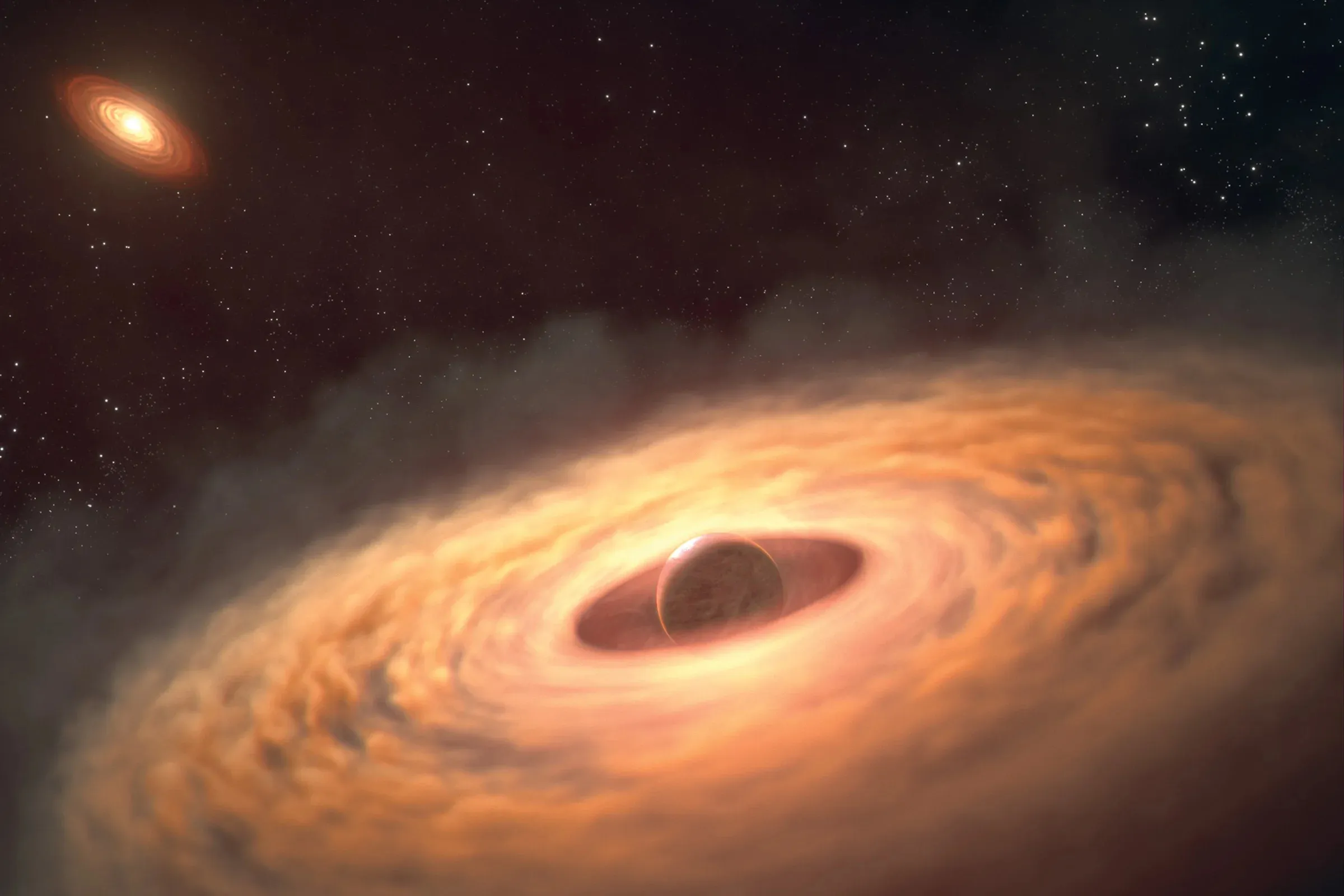
For the first time, researchers have successfully identified molecules within a disk of gas and dust orbiting a distant gas-giant planet. Astronomer Sierra Grant from Carnegie Science in Washington, D.C., expressed surprise at the achievement, noting that such a faint signal would normally be lost in the brightness of a nearby star.
Grant, along with co-author Gabriele Cugno of the University of Zrich, published their findings in Astrophysical Journal Letters. They believe the carbon-rich disk may serve as a nursery for moons and are planning additional observations. Ultimately, they hope to detect potential gaps in these disks created by emerging moons.
The team employed the James Webb Space Telescope (JWST) to capture the infrared glow emitted by the gas and dust surrounding a massive planet called CT Cha b. Detecting light from a planet, much less a disk around it, is extremely challengingakin to spotting a firefly next to a floodlight. The task is easier when the planet is very large and distant from its star. CT Cha b has a mass between 14 and 24 times that of Jupiter and orbits its star at a distance roughly 17 times that of Neptune from the Sun.
Previous studies suggested that CT Cha b was accreting material from an unseen disk. Cugno worked to separate the faint infrared glow of the disk from the overwhelming brightness of the star. Despite initial doubts, Grant was amazed at the results. Cugno describes the process as almost playful in testing JWSTs capabilities.
Ultimately, Cugno extracted a detailed light spectrum from the data, revealing clear chemical signatures of carbon-rich molecules, including hydrogen cyanide, acetylene, and even complex six-carbon benzene ringscompounds not present in the material around the star itself. The findings indicate that the disk could be a zone for moon formation around the planet.
Astrophysicist Danny Gasman of the Max Planck Institute for Astronomy, who was not involved in the study, commented that the discovery may offer clues about the materials available for forming exomoons. Grant notes that CT Cha bs large size and extreme distance make it a promising target but also suggest it may resemble a failed star rather than a typical gas giant.
Understanding disks like the one around CT Cha b can provide insight into the formation of moons both in alien systems and in our own solar system, where the origins of moons remain largely mysterious. Cugno emphasizes, It is difficult to go back 4.5 billion years and imagine how moons formed. Now we can actually witness the process.
Author: Sophia Brooks
Share

Legal experts' opinions on the second US strike on a boat in Venezuela
2 minutes ago 4 min read WORLD

Full support for crackdown on anti-social behavior
2 minutes ago 2 min read WORLD

ERP Seeks Matching Grant of $250,000 to Expand Anti-Poaching Air Wing
3 minutes ago 2 min read WORLD

All Populations on the Largest Continent Share a Common DNA Thread—Except for One
5 minutes ago 2 min read WORLD

Proposals for the renovation of a leisure centre announced
5 minutes ago 2 min read WORLD

Need for foster carers highlighted by festive stockings
6 minutes ago 1 min read WORLD

Three polar vortices cause temperatures to drop in central and eastern U.S. as initial Arctic cold front approaches
6 minutes ago 3 min read WORLD

Authorities seize thousands of illegal cigarettes in raids
8 minutes ago 2 min read WORLD

Macron's ping-pong diplomacy covers up unsuccessful visit to China
12 minutes ago 2 min read WORLD
Final supermoon of 2021, the cold moon, observed throughout the United States: View the images
13 minutes ago 3 min read WORLD