

The Enigmatic Interstellar Object Shows Pulsating in a "Heartbeat Pattern"
- Last update: 3 days ago
- 2 min read
- 63 Views
- SCIENCE
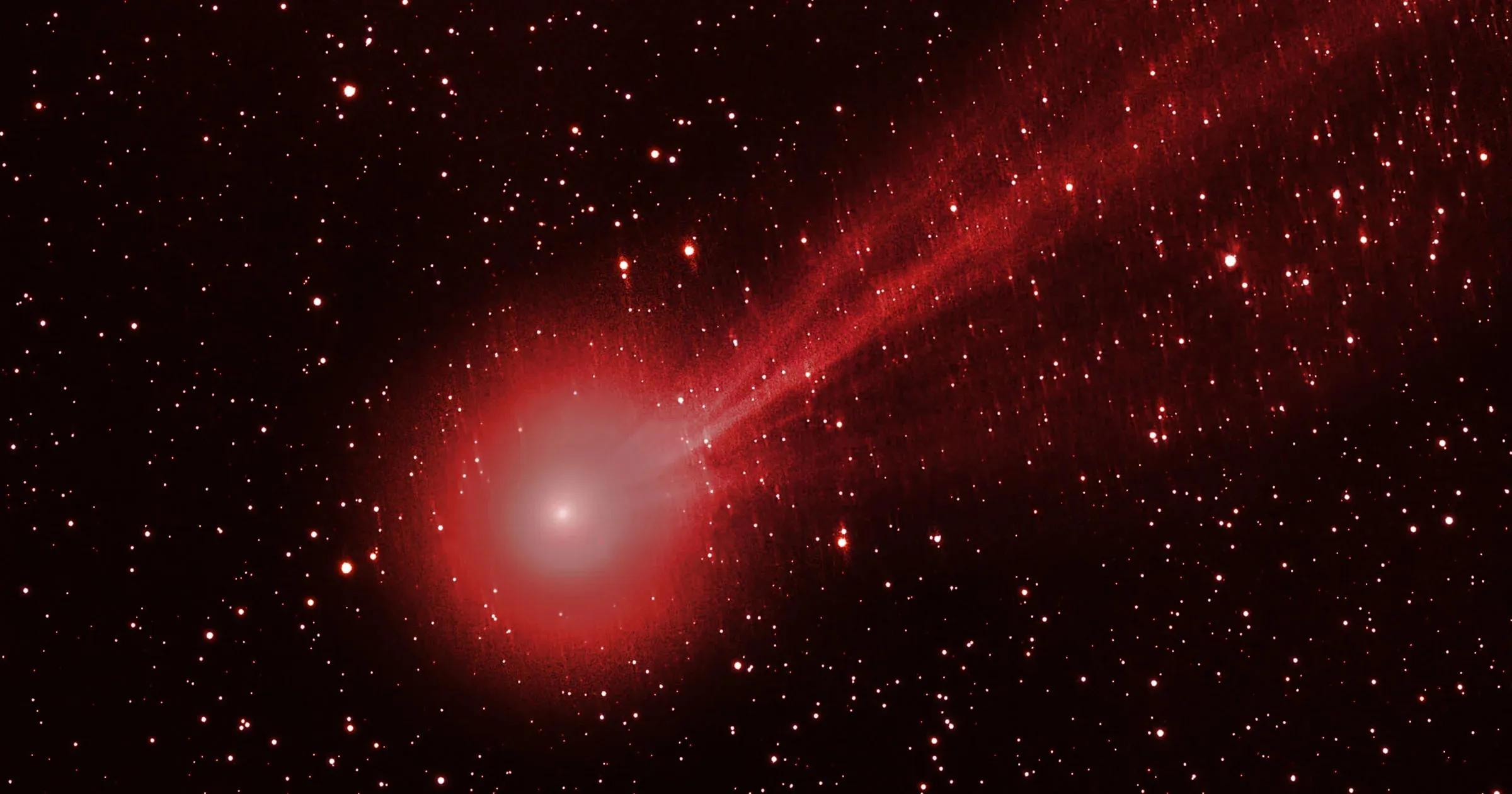
The enigmatic interstellar object 3I/ATLAS is set to make its closest approach to Earth in just a few weeks. On December 19, it is expected to pass within 170 million miles of our planet, offering astronomers a rare opportunity to observe it in detail.
Harvard astronomer Avi Loeb highlights in a recent blog post that this upcoming encounter builds on intriguing observations from ground-based telescopes. Notably, a study published in Astronomy & Astrophysics in October by a collaboration of European and African researchers detected a repeating heartbeat of light from 3I/ATLAS every 16.16 hours.
While some have speculated about extraterrestrial origins, a more conventional explanation is that the object is spinning, creating periodic flashes of light like a cosmic lighthouse. According to the researchers, 3I shows characteristics typical of weakly active outer Solar System comets, despite its interstellar origin. Continued monitoring around perihelion is necessary to track changes in activity and color, providing insights into the evolution of interstellar materials under solar radiation.
If the object is indeed rotating, its unusual anti-taila structure believed to be caused by a region of material less affected by solar radiationmay be directing a stream of particles into its coma, the surrounding cloud of ice and dust. Loeb explains, In a natural comet, a sunward jet (anti-tail) can form when a large pocket of ice on one side of the nucleus faces the Sun. Each rotation causes the coma to swell when the ice pocket is sunlit, producing a heartbeat effect of gas and dust moving through the coma every 16.16 hours.
Most scientists favor the interpretation that 3I/ATLAS is a natural comet, but Loeb remains open to the possibility that its jets could have a technological origin. He notes, For a technological object, the pulsing jets direction might be arbitrary and not necessarily aligned with the Sun. Observing how these pulses evolve over time could clarify the nature of the object, especially since its rotation may have shifted since its perihelion in late October.
Loeb also emphasizes the importance of continuous monitoring: This heartbeat pattern should be visible in a series of well-calibrated snapshots over several days. A time-lapse showing the periodic brightening of the jets could reveal whether the behavior is natural or artificial based on its orientation relative to the Sun.
Author: Sophia Brooks
Share

Elon Musk predicts AI will render most skills irrelevant, but assures his children can still pursue higher education if they choose to
2 days ago 2 min read SCIENCE

What is the current status of SOCOM's AI targeting tests?
3 days ago 3 min read SCIENCE
Scientists uncover unsettling findings about wildfire smoke: 'Unnoticed chemical reactions'
3 days ago 2 min read SCIENCE
Tesla observers verify sightings of long-awaited new model on streets: 'It's an attractive car'
3 days ago 2 min read SCIENCE

Report suggests that the ship fire was probably caused by a battery
3 days ago 2 min read SCIENCE
Researchers discover remarkable effects of structures constructed by wild animals: 'Balancing costs and advantages'
3 days ago 3 min read SCIENCE

Curiosity Uncovered a Big Surprise Inside a Rock on Mars
3 days ago 3 min read SCIENCE

NASA Makes Significant Progress Towards Artemis II's Moon Mission
3 days ago 2 min read SCIENCE
NASA warns scientists about rapid acceleration of ocean changes: 'Speeding up'
3 days ago 2 min read SCIENCE
Surprising find in wetlands a decade after reintroducing extinct beavers: 'Has the potential to change local ecosystems'
3 days ago 2 min read SCIENCE