

Curiosity Uncovered a Big Surprise Inside a Rock on Mars
- Last update: 2 days ago
- 3 min read
- 47 Views
- SCIENCE
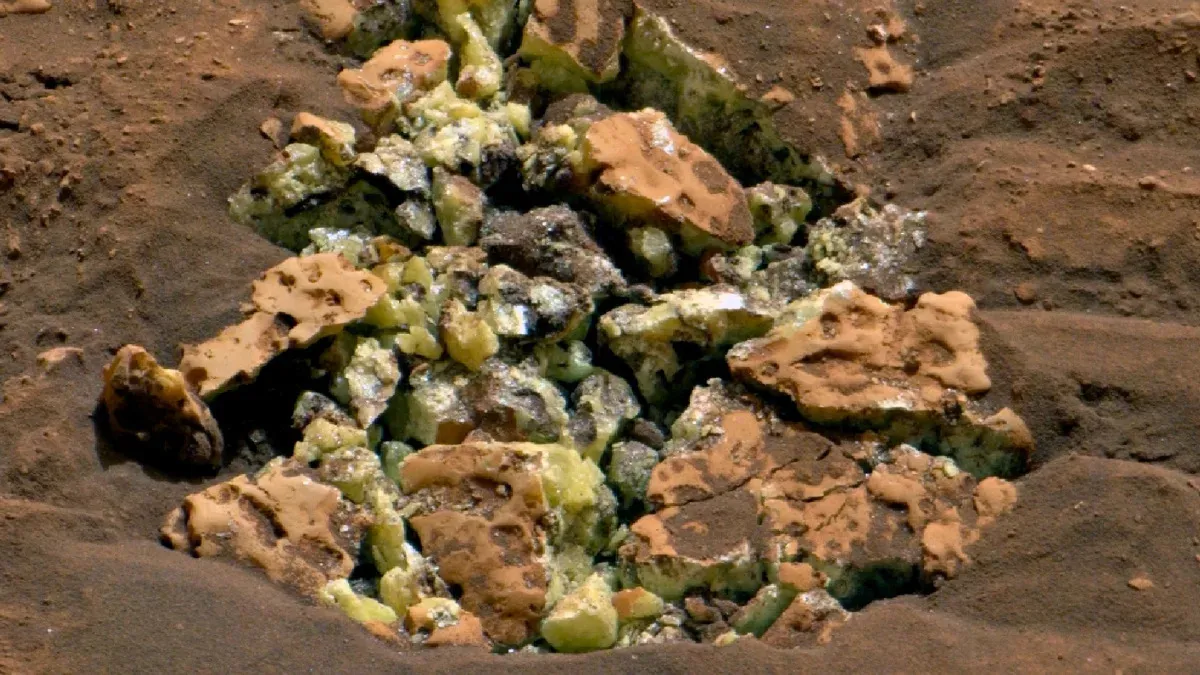
In a surprising turn of events, NASAs Curiosity rover exposed a bright yellow treasure on Mars after accidentally cracking a seemingly ordinary rock. In May last year, as the 899-kilogram (1,982-pound) rover traversed the surface, it rolled over a fragile mineral lump, causing it to break open and reveal vivid yellow crystals of elemental sulfur, also known as brimstone.
While sulfates are commonly found on Mars, this marked the first time pure elemental sulfur has been discovered on the planet. The site of the discovery, Gediz Vallis Channel, contains several other rocks resembling the sulfur specimen before it was fractured, hinting that elemental sulfur could be more widespread in certain areas than previously thought.
"Discovering a collection of pure sulfur stones is like finding an oasis in a desert," said Ashwin Vasavada, Curiosity project scientist at NASA's Jet Propulsion Laboratory, in July 2024. "Its presence is unexpected, which makes explaining it a fascinating challenge. Uncovering such anomalies is the thrill of planetary exploration."
Sulfates form when sulfur, typically in compound form, reacts with other minerals in water. As the water evaporates, these minerals crystallize, leaving behind sulfates that provide clues about Mars water history and geological evolution. In contrast, elemental sulfur forms only under very specific conditions, which were not previously believed to exist in the region where Curiosity made its discovery.
The unexpected presence of pure sulfur on the Martian surface suggests there are unknown factors in Mars geological past. Sulfur is crucial for life, usually absorbed as sulfates and used to synthesize two essential amino acids for proteins. Although no direct signs of life have been found on Mars, discoveries like this highlight elements and conditions that could have supported it.
Curiositys instruments were able to analyze and confirm the sulfur content of the rocks at Gediz Vallis Channel. Had the rover not inadvertently broken the rock, identifying the sulfur might have taken much longer. Rocks similar to the fractured specimen have been photographed, confirming the presence of additional sulfur-rich stones.
Scientists now aim to understand how this sulfur formed on Mars. This will likely involve detailed geological modeling to explain its origins and the environmental conditions that allowed it to exist. Meanwhile, Curiosity continues its survey of Gediz Vallis, exploring the ancient waterway and its rock formations that preserve the history of Mars past rivers.
Curiosity has collected 42 powdered rock samples using its robotic drill, each providing valuable data about the Martian surface. Concurrently, NASA's Perseverance rover continues its mission, moving across the red planet, examining rocks, and making new discoveries. On June 19 of this year, Perseverance set a new record by driving 411 meters in a single stretch, marking the longest journey by a robotic vehicle on another planet.
Both rovers demonstrate humanitys curiosity, determination, and resilience in exploring Mars. Their findings, such as the pure sulfur crystals, continue to expand our understanding of the red planets geology and potential for past habitability.
Author: Sophia Brooks
Share

Elon Musk predicts AI will render most skills irrelevant, but assures his children can still pursue higher education if they choose to
2 days ago 2 min read SCIENCE

What is the current status of SOCOM's AI targeting tests?
2 days ago 3 min read SCIENCE
Scientists uncover unsettling findings about wildfire smoke: 'Unnoticed chemical reactions'
2 days ago 2 min read SCIENCE
Tesla observers verify sightings of long-awaited new model on streets: 'It's an attractive car'
2 days ago 2 min read SCIENCE

Report suggests that the ship fire was probably caused by a battery
2 days ago 2 min read SCIENCE
Researchers discover remarkable effects of structures constructed by wild animals: 'Balancing costs and advantages'
2 days ago 3 min read SCIENCE
Curiosity Uncovered a Big Surprise Inside a Rock on Mars
2 days ago 3 min read SCIENCE

NASA Makes Significant Progress Towards Artemis II's Moon Mission
2 days ago 2 min read SCIENCE
NASA warns scientists about rapid acceleration of ocean changes: 'Speeding up'
2 days ago 2 min read SCIENCE
Surprising find in wetlands a decade after reintroducing extinct beavers: 'Has the potential to change local ecosystems'
3 days ago 2 min read SCIENCE