

The deadly flooding across Asia unleashed by a mix of rogue storms and climate chaos
- Last update: 1 hours ago
- 5 min read
- 401 Views
- WORLD
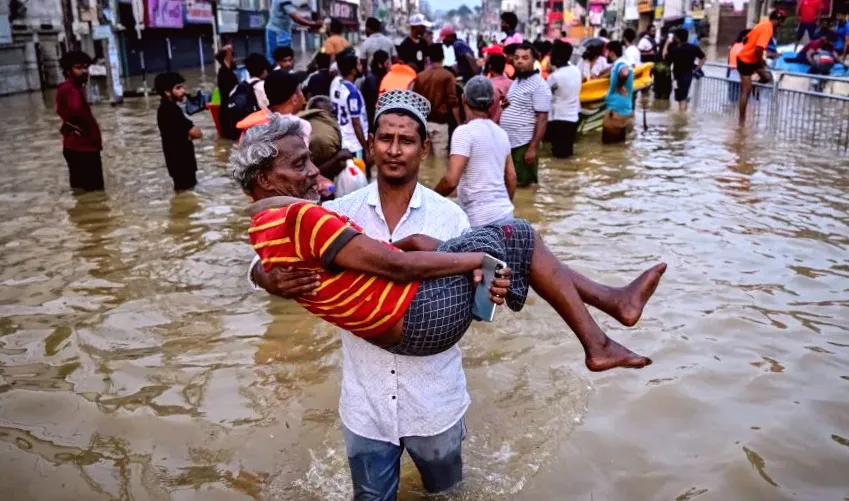
In late November, climatologist Fredolin Tangang observed three tropical storms forming simultaneously across Asia. Despite not being the strongest storms of the year, their occurrence was unusual and alarming. Tangang, emeritus professor at the National University of Malaysia, was reminded of the 2004 disaster film The Day After Tomorrow, though he recognized that such a scenario was far beyond the realm of reality. Yet, there was something about these storms that prompted him to take notice.
The storms were not the most powerful, but they were certainly out of the ordinary. One storm formed near the equator, off the coast of Indonesia, a region where storms rarely develop due to the weak Coriolis force. Another was tracking toward parts of Sri Lanka, an area not typically impacted by tropical storms. The third storm appeared late in the season, threatening to bring more rain to already saturated regions of Vietnam and the Philippines. Tangang remarked, "You realize this is like a monster."
These cyclones unleashed torrential rains and catastrophic flooding across much of South and Southeast Asia, resulting in the deaths of over 1,700 people, according to disaster agencies. Thousands are still missing, likely swept away by floodwaters or buried under mud and debris. While the region is accustomed to seasonal monsoons and occasional flooding, the magnitude of the destruction and loss of life was unprecedented. Scientists warn that the ongoing climate crisis is making such extreme weather events more frequent and intense.
Unusual Storms in Unlikely Locations
Experts have described the deluge as "relentless," "rare," and "record-breaking." Tropical Storm Senyar, forming in the Strait of Malacca between Sumatra and the Malaysian peninsula, was an unusual event. Storms rarely form in this part of the world because the Coriolis effect is too weak near the equator to generate cyclonic activity. However, Senyar defied expectations and intensified, triggering widespread flooding.
In addition to Senyar, Cyclone Ditwah followed an unusual path, striking Sri Lankas east and north coasts, dumping heavy rains on the country's low-lying areas and hill regions, which typically do not face such storms. Meanwhile, Typhoon Koto ravaged the Philippines, triggering floods and landslides before moving toward Vietnam, already overwhelmed by previous storms.
By early November, two powerful typhoons, Fung-wong and Kalmaegi, had already caused significant damage across the Philippines and Vietnam. Kalmaegi killed over 200 people before hitting Vietnam as one of the strongest storms in the region. Central Vietnam was particularly affected, with some areas recording more than 1,700 mm of rainfall in 24 hours, setting a national record. The soaked landscape was ill-prepared for additional rain, and the storm systems that followed only worsened the situation.
Back-to-Back Disasters
As the region struggled to recover from previous storms, additional cyclones such as Koto, Senyar, and Ditwah compounded the disaster. With the land already saturated, the additional rainfall led to severe flooding, overwhelming rivers and inundating entire communities. "The surface was already soaked, and additional rain quickly turned into severe flooding," said Joseph Basconcillo, a senior weather specialist in the Philippines.
The combination of unusual storm tracks, already vulnerable landscapes, and heavy rainfall exacerbated the impact of the flooding. Additionally, two natural climate phenomena, La Nia and a negative Indian Ocean Dipole, were simultaneously occurring, making intense rainfall more likely in the region. While these events alone did not cause the disaster, they created the perfect environment for severe weather.
The Role of Climate Change
Experts agree that climate change has been a significant factor in amplifying the severity of these storms. Southeast and South Asia are particularly vulnerable to the effects of global warming. The region is warming nearly twice as fast as the global average, and hotter oceans provide more energy for storms to intensify. Furthermore, climate change increases the amount of moisture the air can hold, leading to more intense rainfall.
"We are seeing a pattern emergea continuous cycle of catastrophic events," said Davide Faranda, a researcher at the French National Center for Scientific Research. "This cannot become the norm." The frequent storms and record-breaking rainfall are a clear indication that climate change is exacerbating the regions vulnerability, and experts warn that this cycle of extreme weather is likely to continue.
The Need for Action
The catastrophic flooding in Southeast Asia underscores the urgent need for both mitigation and adaptation efforts. A rapid phase-out of fossil fuels, which release planet-warming gases, is essential to reduce the worst impacts of climate change. However, experts emphasize that greater investments are also needed to help vulnerable countries adapt to the increasing severity of extreme weather events.
According to Basconcillo, stronger early warning systems, improved infrastructure, better land-use planning, and nature-based solutions are all critical components of adapting to the new climate reality. Additionally, human-made factors such as deforestation and environmental degradation have worsened the situation, particularly in Indonesia, where illegal logging and palm oil plantations have left the land more susceptible to floods and landslides.
The impacts of corruption are also evident in the Philippines, where protests over flood control projects highlight the failure to address systemic issues. Similarly, Sri Lanka is still grappling with its worst financial crisis in decades, which has left little funding for infrastructure or disaster response.
International Response
At the COP30 summit in Brazil, world leaders agreed to triple the funds available for climate adaptation in vulnerable countries. However, no agreement was reached on a clear path to reduce fossil fuel use or commit to concrete deforestation targets. Experts like Tangang warn that the time for action is now, urging governments worldwide to take climate change seriously and ensure their own regions are prepared for the increasing impacts.
As more rain is forecast for Sumatra and Sri Lanka, and a new storm brews in the east of the Philippines, the region faces an uncertain future. But the need for stronger, more resilient infrastructure and a united global response to the climate crisis has never been more pressing.
Author: Caleb Jennings
Share

Sri Lanka warns of new landslides as death toll reaches 607
15 hours ago 2 min read WORLD

AI-generated clip passed off as real footage of Indonesia flood
20 hours ago 2 min read WORLD

Concerns grow in flood-ravaged Indonesia, Sri Lanka as rain predictions increase
1 days ago 3 min read WORLD
The reasons behind the high number of deaths in floods across Southeast Asia – and why it should be a wake-up call
2 days ago 3 min read WORLD

Scientists say Deadly Asian floods are not a coincidence. They are a warning of climate change.
2 days ago 3 min read WORLD

Scientists say Deadly Asian floods are not a coincidence, but a warning of climate change.
2 days ago 4 min read WORLD
Residents prepare for further destruction following heavy rains that have claimed over 1,300 lives and left hundreds unaccounted for: 'Biggest and most difficult... in our history'
3 days ago 2 min read WORLD

1000 people killed by floods in South and Southeast Asia
4 days ago 1 min read WORLD

Death toll from monsoon rises above 1,000 in 4 Southeast Asian countries
4 days ago 3 min read WORLD

Deadly storms wreak havoc in Asia, claiming over 600 lives and leaving hundreds unaccounted for
5 days ago 2 min read WORLD