

Immigrant Workers Were Recruited, Not Invaded the U.S.
- Last update: 1 hours ago
- 3 min read
- 852 Views
- BUSINESS
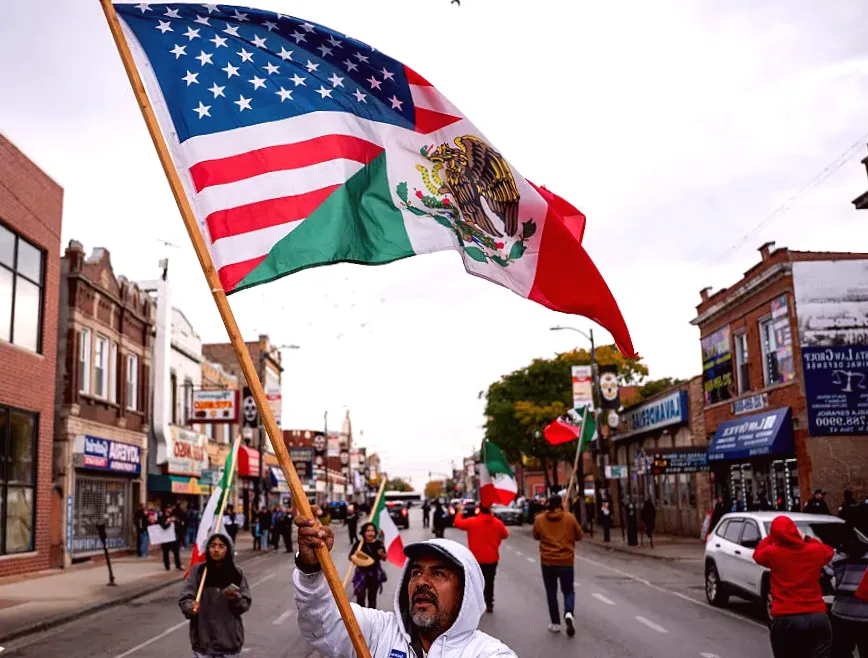
In Chicago's Little Village neighborhood, protesters held flags blending the Mexican and U.S. flags during demonstrations against Immigration and Customs Enforcement (ICE) following recent citywide raids.
A new reality has taken shape in U.S. immigration enforcement. What was once the Border Patrol's practice along remote borderlandschasing immigrantshas transformed into a nationwide strategy targeting major cities. ICE raids and abrupt arrests have become emblematic of a sweeping crackdown on immigrants. Critics urge the agency to operate transparently, revealing the faces behind the masks.
However, the narrative of an "immigrant invasion" often promoted by political figures is misleading. Mexican migration to the United States was not an uninvited flood but a labor solution actively sought by the U.S., especially during and after World War II. The federal government encouraged Mexican migration to fill critical labor shortages in agriculture. This recruitment continued even when Mexico expressed reservations and attempted to limit emigration.
Between 1942 and 1964, the U.S. formally enlisted Mexico to recruit workers and ensure they received fair wages, housing, and food. This arrangement, known as the Bracero Program, brought over four million Mexicans to work in American fields. Initially justified by wartime labor shortages, the program persisted after the war because domestic workers avoided physically demanding farm labor, leaving growers reliant on Mexican laborers who were framed as capable and willing to endure harsh conditions.
Mexico's role shifted over time. By the mid-1950s, mistreatment of migrantssubstandard wages, poor living conditions, and exploitationprovoked criticism at home and abroad. Films, songs, and media highlighted their hardships, prompting Mexico to halt the program temporarily. Officials sought internal labor solutions, proposing state-supported settlements to retain workers domestically. However, the U.S., desperate to maintain farm productivity, bypassed Mexico's restrictions, inviting workers directly and eventually resuming the Bracero Program after negotiations.
This historical episode demonstrates that U.S. agriculture's reliance on Mexican labor was deliberate and strategically managed. Even policies designed to control migration, like Operation Wetback in 1954, did not reduce this dependencethey served more to reassure the public than to limit labor supply. Throughout, employers benefited from cheap, controllable labor, while migrants bore the brunt of regulation and enforcement.
Today, debates around immigration often overlook this foundational truth: Mexican migration to the United States was not spontaneous or invasive. It was cultivated, encouraged, and structured to meet economic needs. The narrative of an "invasion" obscures decades of labor recruitment and the systemic reliance on immigrant workers that persists in agriculture and other industries.
Author: Logan Reeves
Share

Road Report for the Morning of December 5, 2025
50 seconds ago 1 min read BUSINESS

EU Commission denies negative outlook presented in US security strategy
1 minutes ago 2 min read BUSINESS

Autonomous surface vessels to become part of Pentagon’s global C2 network
5 minutes ago 3 min read BUSINESS

Contributor: The left's anxiety about climate change is finally decreasing
7 minutes ago 3 min read BUSINESS

Driver who hit three people with car while drunk sentenced to jail
9 minutes ago 2 min read BUSINESS

EU Commission dismisses negative outlook presented in US security strategy
10 minutes ago 2 min read BUSINESS

Extreme right-wing groups have been networking online long before the internet - and AI is their next target.
11 minutes ago 3 min read BUSINESS

Jimmy Kimmel expresses gratitude to Trump for helping him become the 3rd most trending person in the world in 2025
12 minutes ago 2 min read BUSINESS

European Union agreement on the definition of alcohol-free wine
14 minutes ago 1 min read BUSINESS

Employers have eliminated 1.1 million jobs in 2021. Here's the reason.
16 minutes ago 2 min read BUSINESS