

Roberts and Kagan get ready for another clash over executive authority
- Last update: 2 hours ago
- 3 min read
- 946 Views
- POLITICS
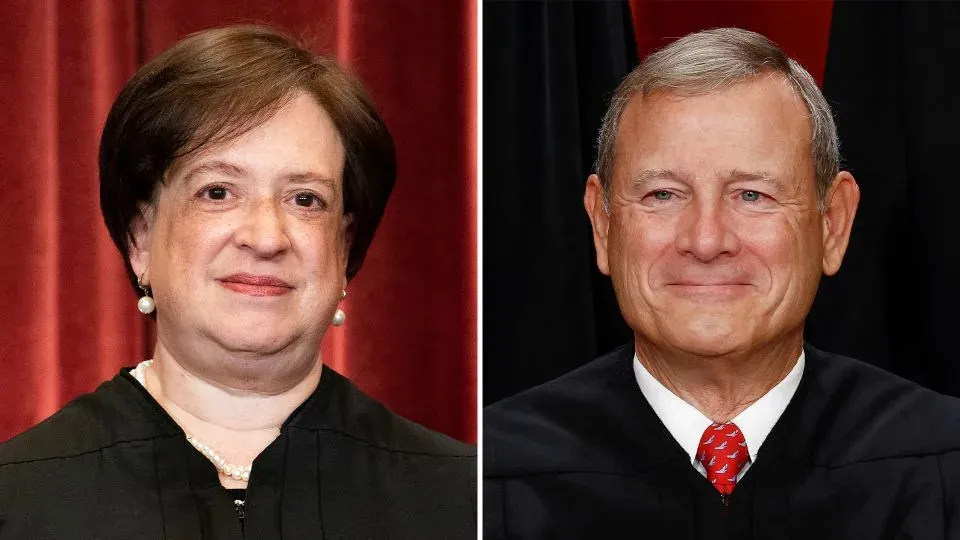
Chief Justice John Roberts and Justice Elena Kagan, long-known for their sharp rhetorical styles, are set to confront each other again on a pivotal question of presidential power: the ease with which the president can remove leaders of independent agencies. This issue will be debated at the Supreme Court on Monday, gaining urgency as President Donald Trump has attempted to dismiss multiple officials, including from the Federal Trade Commission, National Labor Relations Board, and the Federal Reserve.
Their initial encounter on this topic dates back to 2009, when Kagan served as U.S. Solicitor General and Roberts presided as Chief Justice. The dispute revolved around a 1935 precedent, Humphreys Executor v. United States, which safeguards agency independence and now faces scrutiny.
Roberts, whose legal career began in the Reagan administration, has consistently supported broad executive authority, including the presidents power to remove heads of administrative agencies. He argued in 2009 that without such authority, the president could not be fully accountable for executing the laws.
Kagan, by contrast, emphasizes the constitutional separation of powers, allowing Congress to create and protect independent administrative structures. She relies on rulings like Humphreys Executor to argue that Congress can limit the presidents removal authority for cause.
The current case was initiated by former FTC Commissioner Rebecca Slaughter, who received a March 18 email from Trump stating her continued service on the FTC is inconsistent with my Administrations priorities. FTC law allows commissioners to be removed only for inefficiency, neglect of duty, or malfeasance in office. The Supreme Courts decision will have wide-ranging implications across federal regulatory bodies in finance, environment, and public safety.
Earlier in the litigation, Roberts majority reversed a lower court ruling that would have kept Slaughter in office. Kagan dissented, asserting that Humphreys Executor still restricts presidential removal power.
Historically, Roberts and Kagan have repeatedly faced off on these issues. As Solicitor General, Kagan defended Congress authority to protect certain agency officials, while Roberts challenged these protections as unconstitutional constraints on the president. Their first significant clash involved the Sarbanes-Oxley Act of 2002, which limited the removal of Public Company Accounting Oversight Board members for cause.
Roberts stance on presidential authority draws on the unitary executive theory, developed during the Reagan era, which argues that the president must control executive branch officials fully. Kagan, in dissenting opinions, has warned against an overly rigid interpretation of separation of powers, emphasizing that independent agencies play an essential role in governance.
In 2020, Roberts led the court to strike down the leadership structure of the Consumer Financial Protection Bureau, reinforcing his view that the presidents removal power is central to executive accountability. Kagans dissent criticized this approach as a simplistic reading of constitutional powers, likening it to a Schoolhouse Rock civics lesson.
As the Slaughter case progressed, lower courts initially sided with her, citing the 1935 precedent. However, the Supreme Court allowed Trump to remove her while the appeal is pending. Additional cases concerning the removal of Federal Reserve officials are also under review.
Slaughters legal team argues that independent agencies are a longstanding feature of U.S. governance and that overturning precedent would destabilize institutions crucial to federal administration. The Trump administration, represented by Solicitor General D. John Sauer, leans on Roberts previous rulings to assert that the president holds broad removal powers over executive agencies, framing them as essential to the faithful execution of the law.
Author: Riley Thompson
Share
Supreme Court to consider Trump's dismissal of FTC member in examination of presidential authority
1 hours ago 3 min read POLITICS

Grand jury decides not to bring new charges against Letitia James
4 hours ago 2 min read POLITICS

DOJ unable to obtain new indictment of James from grand jury
9 hours ago 2 min read POLITICS

A pattern of discrimination alleged by Black men fired from key transportation boards under Trump
20 hours ago 3 min read US

DOJ expected to request new indictment for Letitia James: Report
23 hours ago 2 min read POLITICS
A potential second Comey indictment could face a new challenge with the Statute of Limitations
2 days ago 3 min read POLITICS

Trump Attempts to Exclude Congress from U.S. Attorney Appointments
2 days ago 3 min read POLITICS
Justice Department considers filing charges against James Comey again — but without Lindsey Halligan as lead prosecutor
2 days ago 3 min read POLITICS

Court rules that ex-Trump lawyer Alina Habba is illegally acting as US attorney for New Jersey
2 days ago 3 min read POLITICS
So far, these are all of the political enemies of Trump who have been charged or investigated
2 days ago 3 min read POLITICS