

Elephants' Acceptance of Drones Could Help Conservation Efforts
- Last update: 3 days ago
- 2 min read
- 39 Views
- SCIENCE
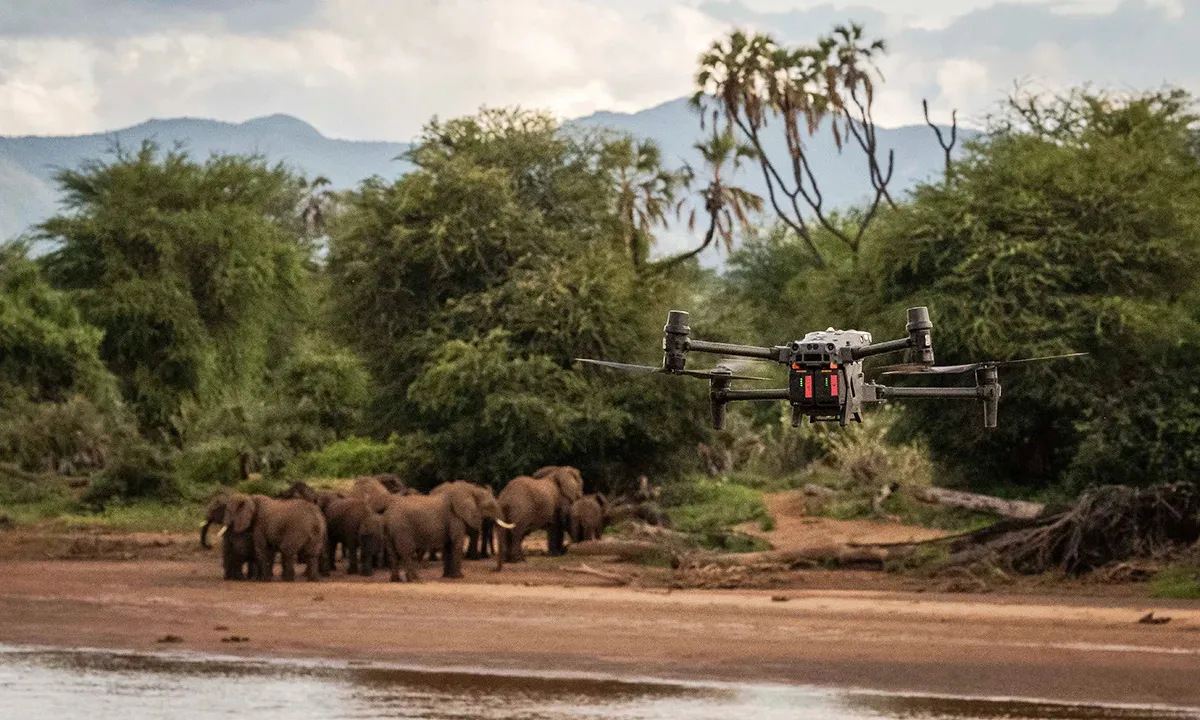
The saying that an elephant never forgets is more than just a proverb. With exceptional spatial memory and the capacity to recognize both human and elephant faces, these majestic animals continue to astonish researchers with their cognitive abilities. Recent studies suggest that this impressive memory may play a crucial role in conservation efforts for endangered elephants.
African elephants, the largest land mammals, may use their memory to adapt to drones designed to gather essential data for protecting their populations, according to a research team from the conservation organization Save the Elephants. Their findings were recently published in Scientific Reports.
Initially, African savannah elephants (Loxodonta africana) encountered drones as tools for deterring herds from cropsa common problem in parts of Africa. Drones flown within 50 meters startled the elephants due to noise and flashing lights, causing them to flee. Consequently, drones were not previously considered a viable method for monitoring these animals.
To investigate further, scientists from Save the Elephants, University of Oxford, Sussex University, and University of Colorado, Boulder conducted 35 drone trials in two northern Kenyan reserves. They observed elephant responses to determine whether the animals could become accustomed to drone presence over single and repeated exposures.
Researchers implemented careful protocols to reduce disturbances, including launching drones from at least 1,600 feet away and always on the downwind side to minimize noise. Disturbance behaviors were recorded in roughly half of the trials, with elephants pausing feeding, lifting trunks, or shaking their heads. However, these reactions generally lasted only the first minute, after which the elephants resumed normal behavior.
Remarkably, some elephants displayed reduced sensitivity in subsequent drone exposures, even after nearly a year (355 days) between encounters. Our results suggest that these habituation effects may last over many months if not years, demonstrating the capacity for learning and adaptability for which elephants are already well known, stated co-author Angus Carey-Douglas of Save the Elephants.
This newfound tolerance to drones presents a non-intrusive and cost-effective method for monitoring elephant herds. Being large, social animals, elephants are well-suited to drone-based research, which can capture data on both individual and social behaviors using aerial cameras and sensors.
This research demonstrates the power of a new and rapidly evolving technology that allows us to probe ever deeper into the secret lives of elephants, commented Fritz Vollrath, evolutionary biologist at the University of Oxford and co-author of the study.
Author: Sophia Brooks
Share

Elon Musk predicts AI will render most skills irrelevant, but assures his children can still pursue higher education if they choose to
3 days ago 2 min read SCIENCE

What is the current status of SOCOM's AI targeting tests?
3 days ago 3 min read SCIENCE
Scientists uncover unsettling findings about wildfire smoke: 'Unnoticed chemical reactions'
3 days ago 2 min read SCIENCE
Tesla observers verify sightings of long-awaited new model on streets: 'It's an attractive car'
3 days ago 2 min read SCIENCE

Report suggests that the ship fire was probably caused by a battery
3 days ago 2 min read SCIENCE
Researchers discover remarkable effects of structures constructed by wild animals: 'Balancing costs and advantages'
3 days ago 3 min read SCIENCE

Curiosity Uncovered a Big Surprise Inside a Rock on Mars
3 days ago 3 min read SCIENCE

NASA Makes Significant Progress Towards Artemis II's Moon Mission
3 days ago 2 min read SCIENCE
NASA warns scientists about rapid acceleration of ocean changes: 'Speeding up'
3 days ago 2 min read SCIENCE
Surprising find in wetlands a decade after reintroducing extinct beavers: 'Has the potential to change local ecosystems'
3 days ago 2 min read SCIENCE