

Study shows Amazon's massive anacondas were at their largest size 12 million years ago
- Last update: 3 days ago
- 3 min read
- 41 Views
- SCIENCE
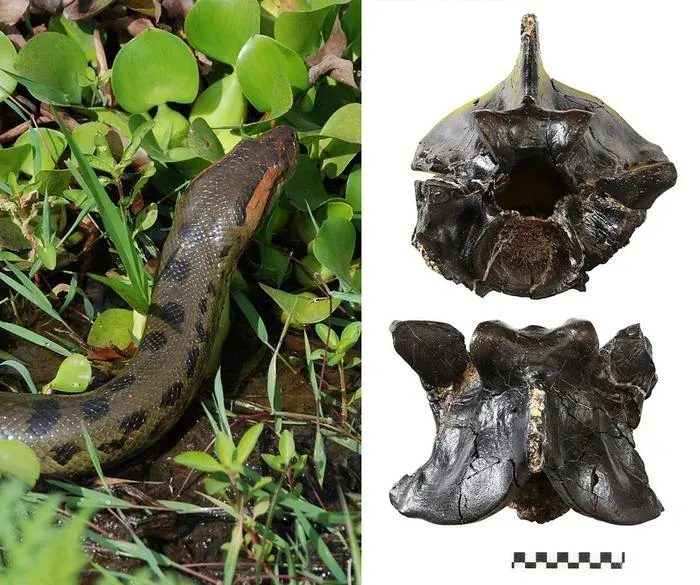
A recent analysis of anaconda fossils reveals that these snakes achieved their largest size around 12.4 million years ago and have maintained it ever since. While modern anacondas typically measure 4 to 5 metres, some can grow up to 7 metres. In this study, a research team from the University of Cambridge examined 183 fossilized vertebrae discovered in Falcn State, Venezuela, representing at least 32 individual snakes. Calculations indicate that these ancient anacondas were also between four and five metres long, similar to their living counterparts in the Amazon.
By examining these fossils, we discovered that anacondas developed a large body size soon after emerging in tropical South America about 12.4 million years ago, and their size has remained stable ever since, explained Andrs Alfonso-Rojas, the studys lead author. This persistence shows that anacondas withstood climate shifts that caused the extinction of other large species.
During the Middle to Upper Miocene, from 12.4 to 5.3 million years ago, many animal species were larger than their modern descendants due to warm climates, expansive wetlands, and abundant food. Massive creatures like the 12-metre caiman Purussaurus and the 3.2-metre freshwater turtle Stupendemys inhabited northern South America, but these giants eventually vanished. In contrast, anacondas survived and retained their impressive size.
Other giant species, such as enormous crocodiles and turtles, disappeared after the Miocene, likely because of cooler temperatures and shrinking habitats, but anacondas proved incredibly resilient, noted Alfonso-Rojas, a PhD student and Gates Cambridge Scholar in the Department of Zoology.
The team confirmed their measurements using ancestral state reconstruction, which maps the evolutionary tree of snakes to estimate the body lengths of ancient anacondas and related species, including tree boas and rainbow boas. This method supported the initial finding that Miocene anacondas averaged four to five metres in length.
These results challenge the assumption that snakes, being cold-blooded, would only reach their maximum size during the warmest periods. We expected to find snakes seven or eight metres long in the Miocene, but no evidence of larger specimens exists from that era, Alfonso-Rojas said.
The true remarkable aspect is not the size itself but the species ability to endure global cooling. Researchers suggest that their aquatic habits and versatile diet played a crucial role. Miocene wetlands in northern South America resembled todays Amazon, offering widespread suitable habitats. Even with environmental changes, sufficient swampy areas and prey, such as capybaras and fish, allowed anacondas to sustain their large size.
The study was published in the Journal of Vertebrate Paleontology on December 1.
Author: Sophia Brooks
Share

Elon Musk predicts AI will render most skills irrelevant, but assures his children can still pursue higher education if they choose to
3 days ago 2 min read SCIENCE

What is the current status of SOCOM's AI targeting tests?
3 days ago 3 min read SCIENCE
Scientists uncover unsettling findings about wildfire smoke: 'Unnoticed chemical reactions'
3 days ago 2 min read SCIENCE
Tesla observers verify sightings of long-awaited new model on streets: 'It's an attractive car'
3 days ago 2 min read SCIENCE

Report suggests that the ship fire was probably caused by a battery
3 days ago 2 min read SCIENCE
Researchers discover remarkable effects of structures constructed by wild animals: 'Balancing costs and advantages'
3 days ago 3 min read SCIENCE
Curiosity Uncovered a Big Surprise Inside a Rock on Mars
3 days ago 3 min read SCIENCE

NASA Makes Significant Progress Towards Artemis II's Moon Mission
3 days ago 2 min read SCIENCE
NASA warns scientists about rapid acceleration of ocean changes: 'Speeding up'
3 days ago 2 min read SCIENCE
Surprising find in wetlands a decade after reintroducing extinct beavers: 'Has the potential to change local ecosystems'
3 days ago 2 min read SCIENCE