

What were the results of the meeting in Delhi for Putin and Modi?
- Last update: 1 hours ago
- 3 min read
- 415 Views
- WORLD
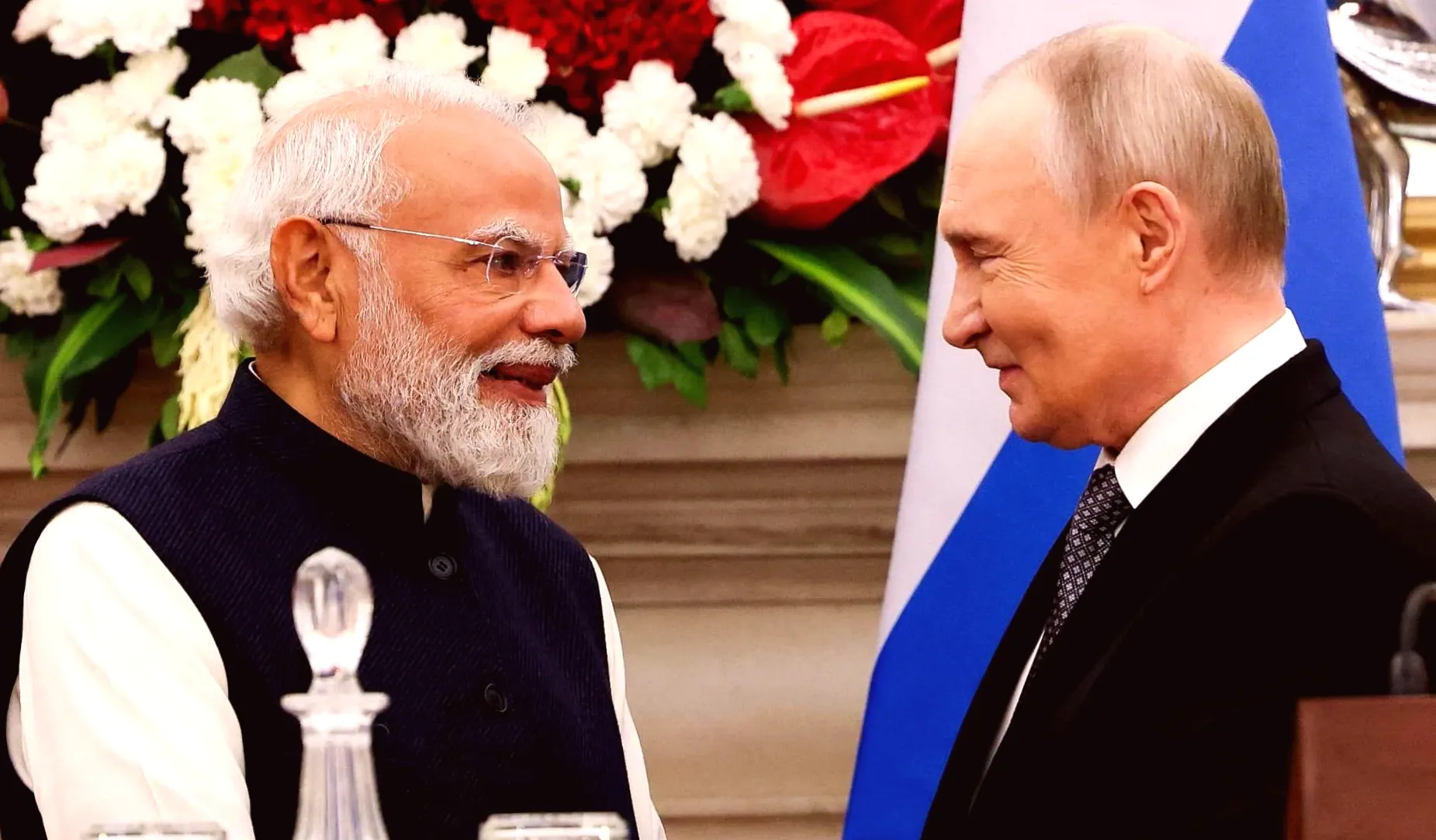
Russian President Vladimir Putin concluded a busy day in India at a ceremonial dinner at the presidential residence, where his visit had begun with a morning guard of honour. During the day, he engaged in discussions with Prime Minister Narendra Modi, attended a business forum, and announced the launch of Russia Today, a Kremlin-funded media network.
Since the start of the Ukraine war in 2022, Putin has faced significant diplomatic isolation, and the grandeur of his reception in Delhi sent a clear message to the West.
Grandeur Over Substance
The welcome extended to Putin was lavish. Russian media described it as a "cavalcade, cannon volleys, and a 340-room palace reception," highlighting the stark contrast to efforts in the West to portray him as a pariah.
Despite the ceremonial pomp, concrete agreements were relatively limited. Nevertheless, both Russia and India reinforced their "special and privileged strategic partnership," with Putin praising the expansion of bilateral cooperation. Agreements covered areas such as economic collaboration, critical minerals, supply chains, and pharmaceuticals, including a new Russian-Indian pharmaceutical factory in Kaluga.
Oil and Defence: Sensitive Issues
India has been a major purchaser of Russian oil, a move that has drawn criticism from the United States. While Putin confirmed Moscow's readiness to maintain uninterrupted oil supplies to India, no specific terms were disclosed, leaving decisions in India's hands.
Speculation about India acquiring advanced Russian fighter jets and air defence systems did not materialize into any announced deals. This reflects India's delicate balancing act between its longstanding ties with Russia and its strategic relationship with the United States.
Trade as the Central Focus
The visit began with a highly symbolic gesture as Modi personally greeted Putin at the airport, emphasizing the importance India places on its relationship with Russia. Yet, the ceremonies did not yield major defence agreements or guarantees for discounted Russian crude imports.
Statements from the leaders highlighted mutual respect but lacked blockbuster announcements. Trade emerged as the focal point of the visit. Both countries are seeking alternative markets to offset Western sanctions and tariffs, with India and Russia recognizing their underutilized economic potential. Bilateral trade has grown from $8.1 billion in 2020 to $68.72 billion, largely due to Indian oil purchases. Putin's assurances of uninterrupted energy shipments subtly encouraged India to resist U.S. pressure.
Agreements Beyond Defence and Oil
The countries signed deals in sectors such as shipbuilding, maritime training for polar operations, new shipping routes, civil nuclear energy, visa-free travel, and critical minerals. Modi emphasized expanding business ties, reflecting India's search for new markets. Progress was noted on India's potential free trade agreement with the Eurasian Economic Union (EAEU), which includes Russia, Armenia, Belarus, Kazakhstan, and Kyrgyzstan, opening opportunities for broader market access.
The two leaders also discussed a five-year economic framework aimed at achieving $100 billion in bilateral trade, a goal that would require growth beyond oil purchases. The emphasis on diversified trade underscores the strategic focus of the visit.
Defence Cooperation Continues
The absence of a major defence contract does not diminish Russia's longstanding role in supplying India's armed forces. While India has not publicly committed to purchasing Su-57 fighter jets, it may have prioritized timely delivery of existing defence orders, such as the S-400 air defence systems, which are delayed due to Russia's focus on Ukraine. Discussions on larger defence deals likely continue behind the scenes.
Overall, the visit highlighted ceremonial grandeur and reinforced trade and economic ties, with defence discussions and energy security remaining important but largely unannounced components.
Author: Harper Simmons
Share
‘Continuous oil deliveries’: Main points from Putin-Modi discussions in Delhi
49 minutes ago 4 min read WORLD
What were the results of the meeting in Delhi for Putin and Modi?
1 hours ago 3 min read WORLD
Despite Pressure from Trump, Putin Finds Willing Trade Partner in India
1 hours ago 2 min read WORLD
Putin assures Russia's commitment to provide 'continuous' fuel supply to India
1 hours ago 3 min read WORLD
Putin opposes US pressure on India regarding Russian oil during state visit
4 hours ago 3 min read WORLD
Putin's visit to Delhi puts oil and trade in spotlight
7 hours ago 1 min read BUSINESS

India warmly welcomes Russia's Putin
7 hours ago 2 min read WORLD
Putin and Modi start India summit amid looming trade and US sanctions
7 hours ago 3 min read WORLD
Putin and Modi to discuss trade and defense ties between Russia and India amidst US pressure
8 hours ago 3 min read WORLD

Putin shows support to Modi amid US tariffs on India
21 hours ago 2 min read BUSINESS